
ROLES
The role of the “suffering” one is carried by many people – including many artists – throughout an entire lifetime.
Some create this energy within themselves with such passion and boldness that a less wounded person might not even be capable of it.
This cannot be forced: it either comes, or it doesn’t.
The possible advantages of suffering can be used for self-expression in countless ways, yet it is also dangerous to get stuck in it.
Some take on this identity to such an extent that it eventually becomes a defining part of their lives.
Ultimately, this too is a romanticized role that compensates for false beliefs.
And like every role, it sooner or later leads to burnout.
It may be that somewhere, something hurt so deeply that over time it became easier to cover it up and act out the opposite, gaining certain advantages as a result.
Recognition, attention, and so on.
The list is long.
Perhaps we have been compensating for a previously experienced trauma ever since, while on a deeper level we long ago shut down our emotions so that we would not have to relive the pain.
If, however, a “heartbreak” is not resolved, the pattern repeats itself again and again in different forms.
It may appear through different life situations, but in the background the unresolved root energy is always present.
Many create their personal reality by building it upon a false sense of life, in which—hiding behind their numbed, burnt-out emotions—they beautify suffering and the possible advantages that come with it.
For example, self-expression.
This is a vicious circle that we ourselves create.
On the surface, of course, this is not always clear, because the main threads are driven by the subconscious and unconscious mind projecting our beliefs.
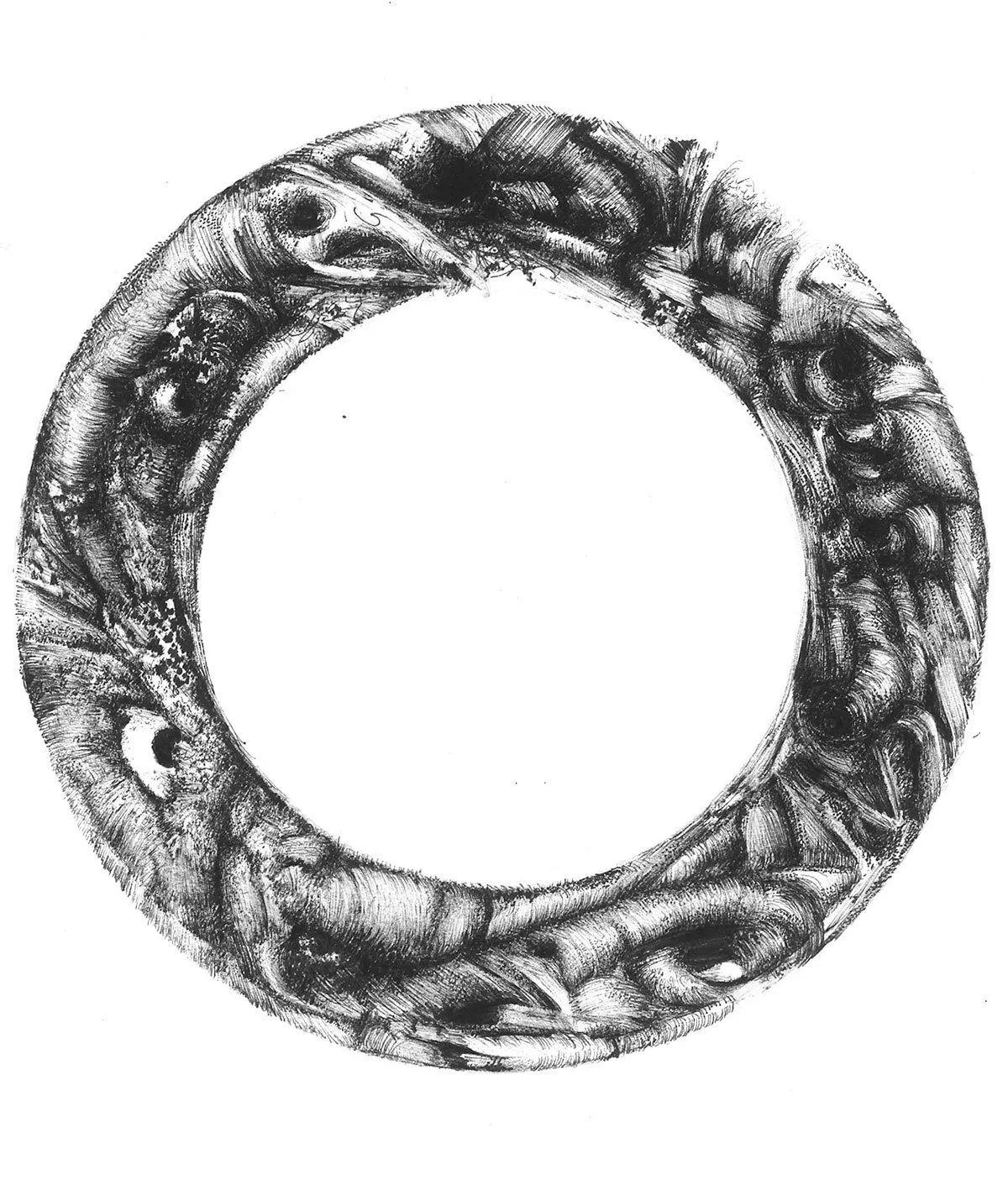
Iniciálé, 2017 — an imprint of an early graphic period.
“Suffering is also part of life.”
“That’s what makes it so deep.”
“There is something beautiful and special in it.”
Many such sponsoring thoughts are running in the background.
Just as I have heard similar self-pitying, responsibility-avoiding, and suffering-romanticizing “wisdoms” from others, I have also heard them from my abstract artist persona.
Yet it is not the role we should accept, but an openness to change.
The capacity and willingness to get to know ourselves, so that by letting go of the roles that compensate for our traumas, we dare to step into who we truly are.
But where, and in what way, do we find our “true self”…?
Nowhere else than beneath our traumas, by resolving them.
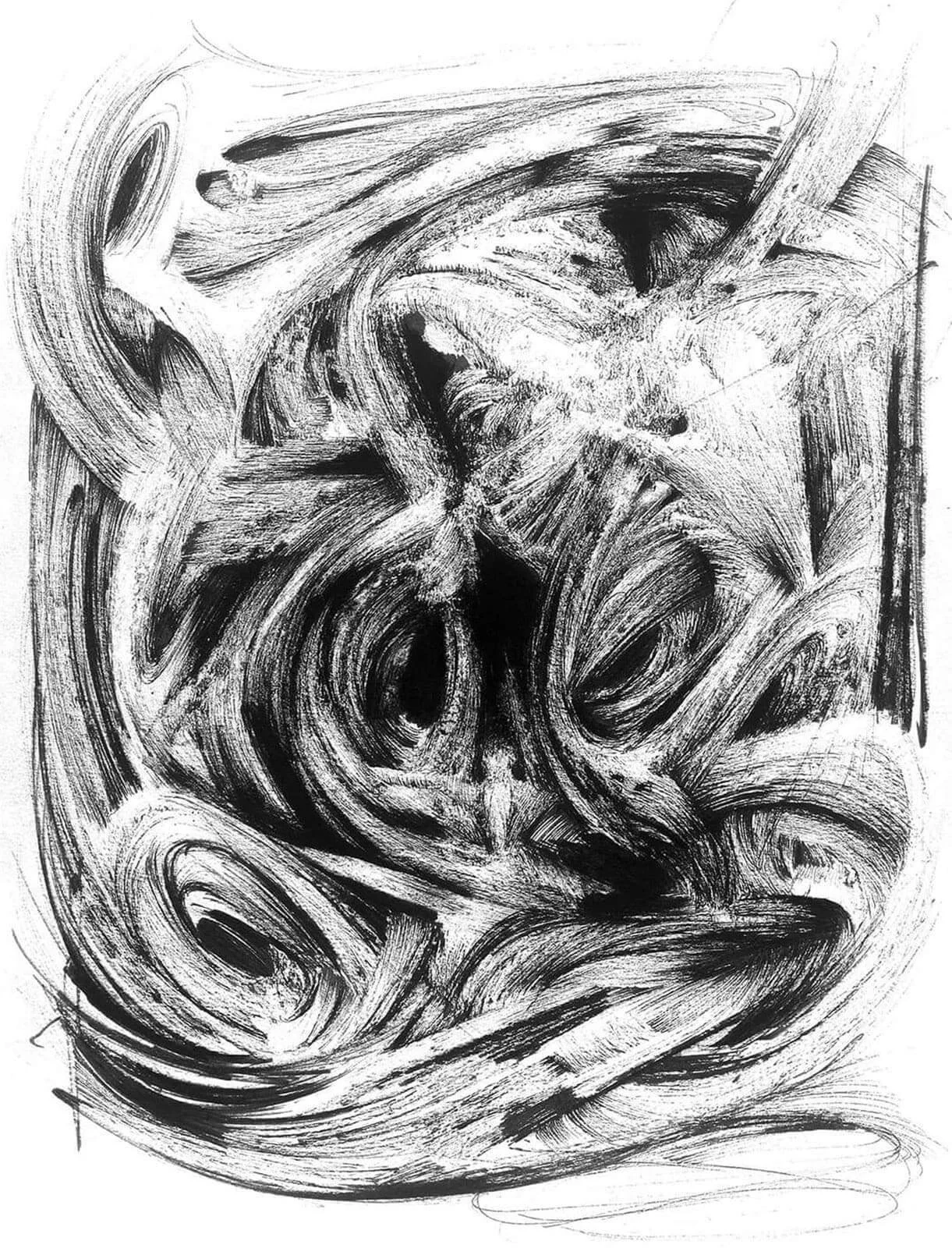
A regressive process manifested, 2020.
This is a long and complex process, which, from an artistic perspective, can also manifest in the outer world through intriguing imprints.
You will not find either yourself or your assigned life purpose overnight. This is rather a slowly maturing connection, the details of which sometimes only become clear in hindsight.
If, as a conscious observer, you notice how differently you react, for example, to certain situations compared to a few months or years earlier.
If you see how different things interest you, how differently you express yourself, how different your overall state feels, and so on.
An endless process.
Back in 2016, I would never have thought that the loud, unhinged version of myself—constantly running away from home—would soon cease to exist.
After so many years of chaos, it simply burned out, and eventually a “pattern-breaking” accident tore down the last remaining pillars.
Following this, a slow connection began to unfold with another self of mine that had been separated for decades.
The very first visible signs of a long process started to appear.
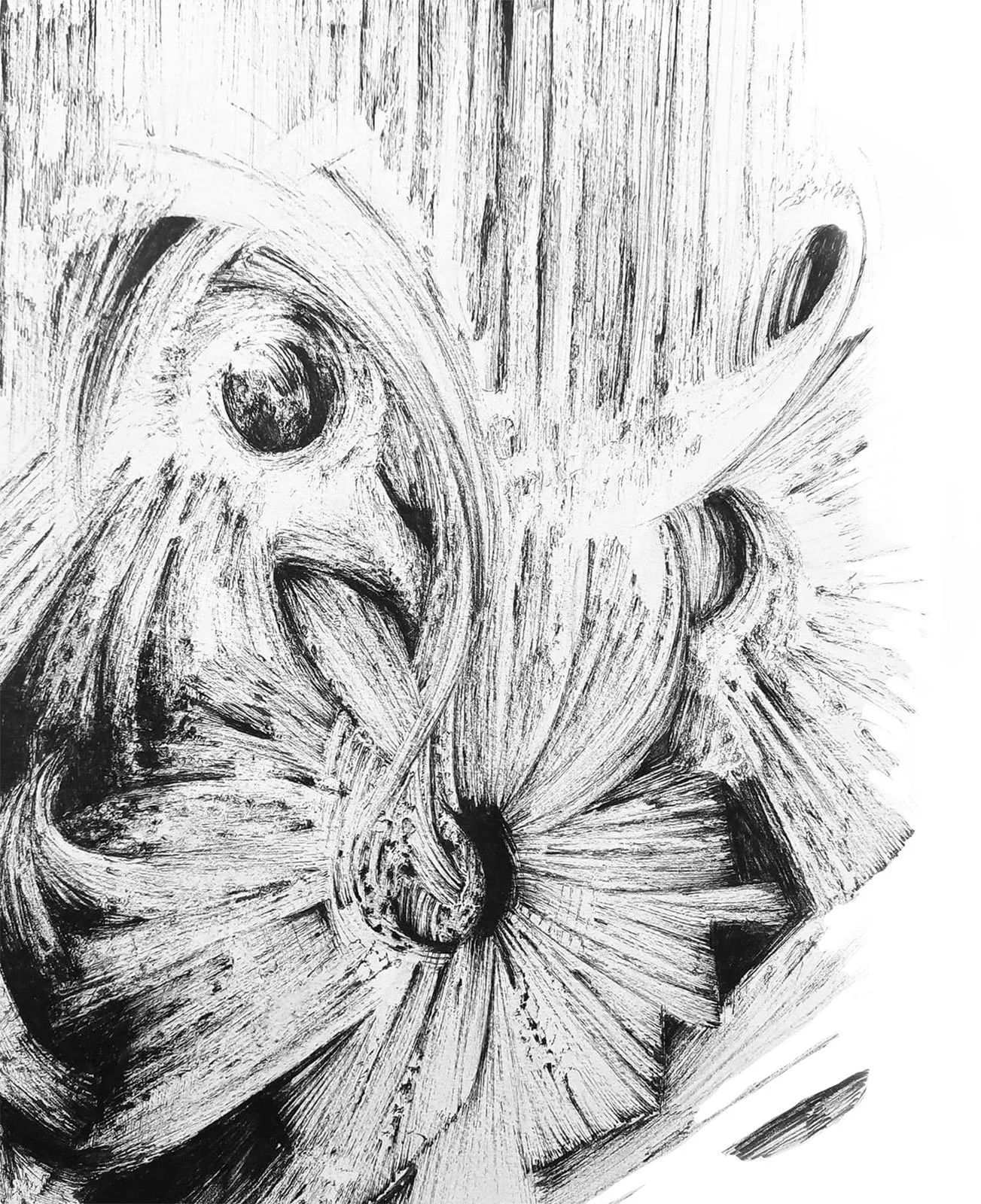
Organic impressions from 2019
The unfolding of my artistic practice was also a manifestation of change, one that accompanied the new qualities awakening behind my shedding layers.
It came hand in hand with this process.
Each of them revealed different faces, taking shape through new graphic and painterly styles.
Not as if this happened from one day to the next.
Yet relatively quickly, over the course of just a few years, a depth of healing took place that greatly contributed to everything I later articulated through illustrations and paintings.
It was as if the energy accompanying this process shaped the character of the gestures, lines, and patches of color—something that at the time was still partly an unconscious process.
I say this because, on a professional level, I have always approached my work analytically, yet for years I did not connect it to this process.
In hindsight, however, I can see that the development of my way of seeing is connected to those moments when I reached deeper levels in my inner work.
I never wanted to express this in such a direct way; on the contrary, I kept it deliberately separated, thereby preserving my objectivity.
This “paint your pain out of yourself” approach never worked for me. When I was at a low point, I mostly just lay down or went walking in the nearby forests.
And yet, at major turning points, a new, still-unfolding graphic language would often appear, whose character revealed a great deal about the energetic processes taking place at the time.
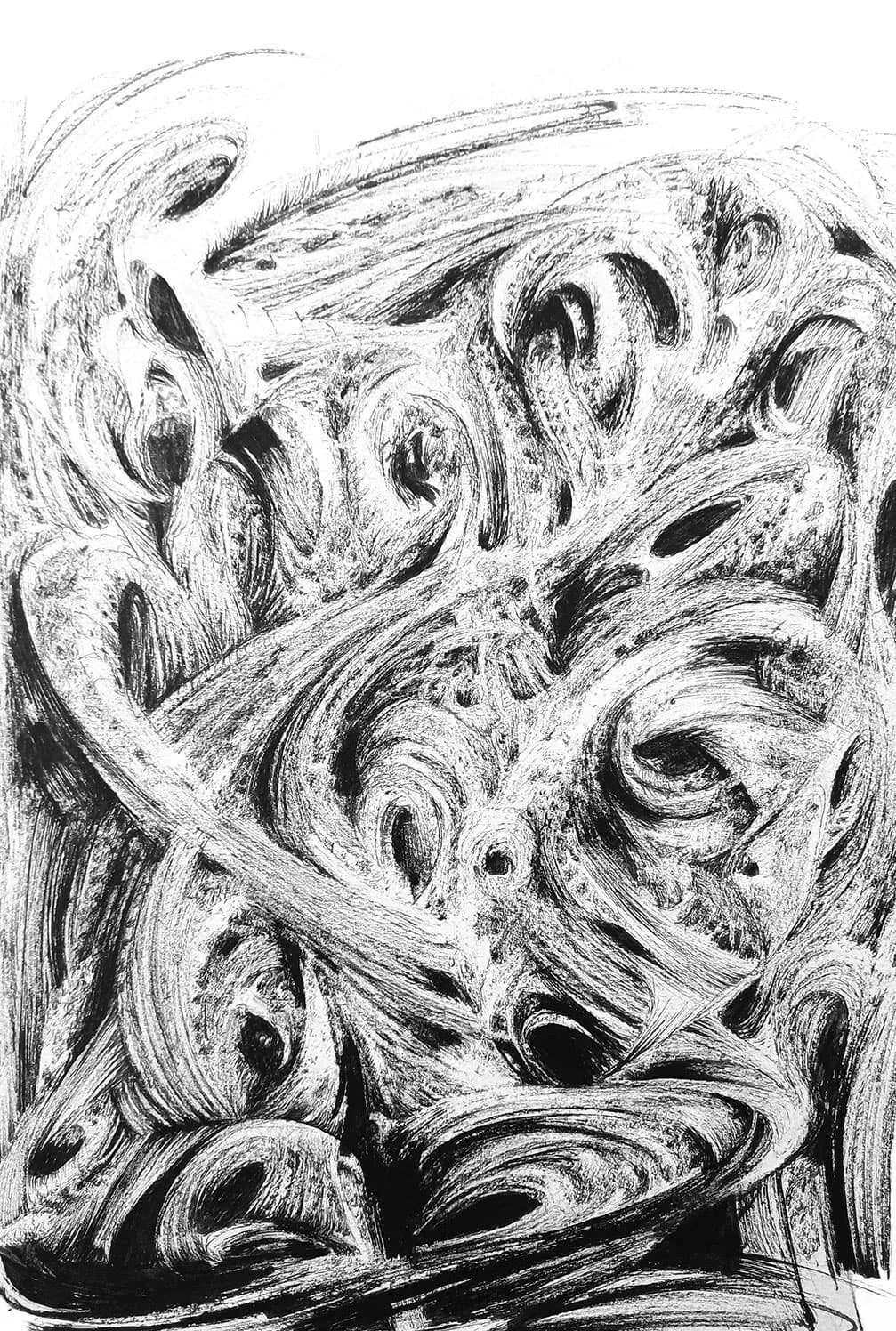
Confronting and releasing the root causes of anxiety.
By 2018, such intense pressure had built up within me that, as a result of the releases I had begun, I erupted like an awakened volcano, expelling everything that had accumulated deep inside.
A brutally intense regressive process began.
For roughly two to three years, its intensity manifested as an emotional rollercoaster, bringing to the surface emotional imprints stemming from various transgenerational and, above all, childhood traumas.
Then something slowly shifted, and a change occurred that I experienced as nothing short of a miracle.
Not that this meant the process was over afterward.
I do not want to present this as if I had already worked through everything, with Christ-like consciousness and so on.
There was a massive bundle within me, the emptying of which brought about beautiful experiences—among them the lifting of a “family curse,” that is, the resolution of anxiety-related depression—while I also learned to connect with a higher, creative self.
These are just two items from a longer list of what inner work has brought into my life.
Of course, this by no means suggests that I do not still have many bundles waiting to be resolved.
Oh dear…
Some people who know me would probably laugh now.
The truth is that I still have plenty of blockages in different areas of my life; yet I find that the time invested in inner work continuously loosens and improves them.
This is a great deal of work, which, among other things, involves integrating the “shadows” hidden within the layers of the subconscious and resolving traumas.
This task is far from finished.
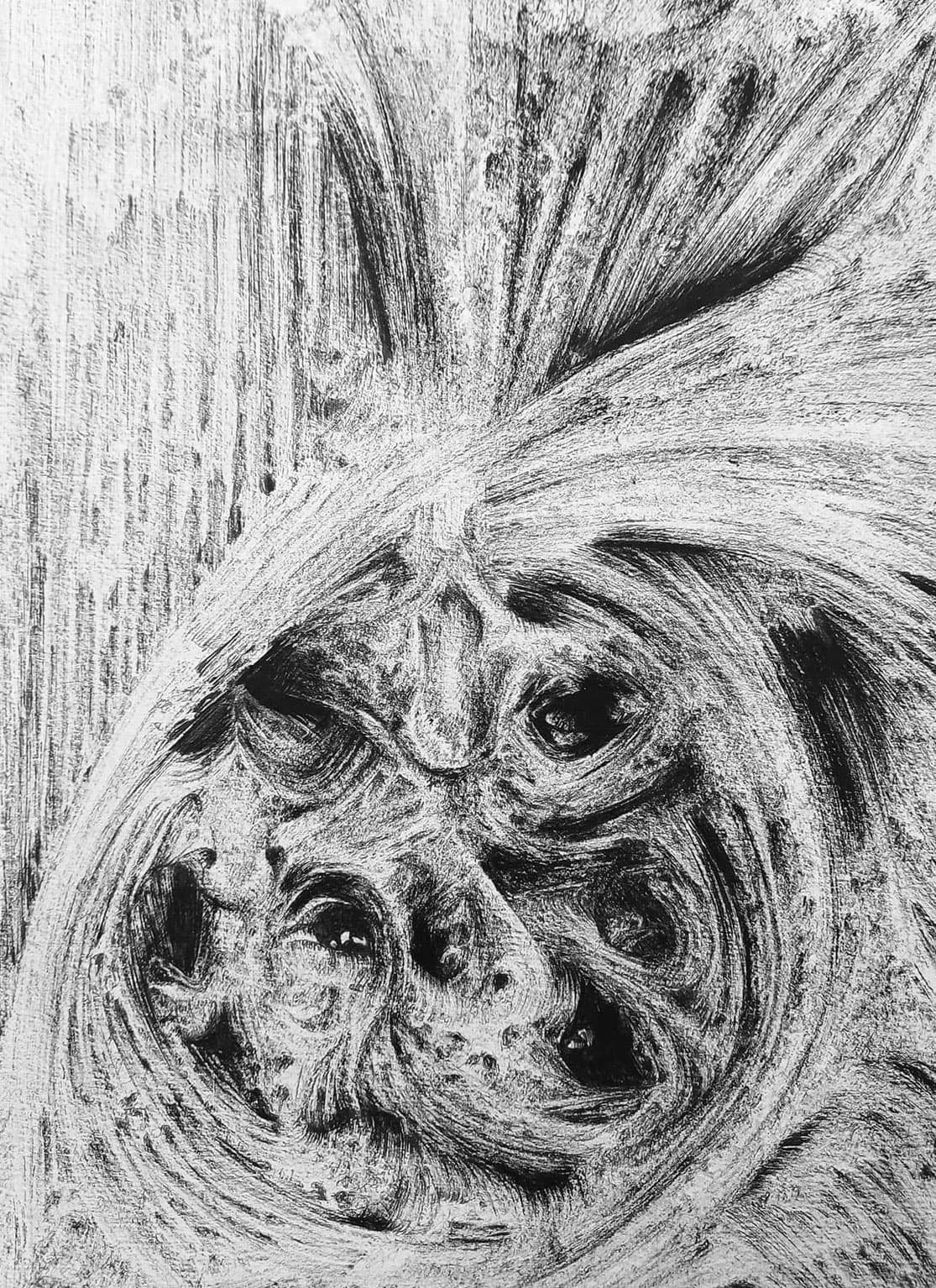
Forest textures coming to life.
But then — to start at the beginning.
In the autumn of 2016, when the studio began to pull me in, I wasn’t thinking about any of this yet. I was simply filled with curiosity and a sense of temporary calm by that 50 square meters packed with sculptures, still lifes, and drawing boards.
Translating something from three dimensions into two was far from simple, especially after having copied so much from photographs. I honestly remember thinking: wow… I didn’t know I could do this.
Then my drawing teachers’ first reactions shattered that early sense of self-satisfaction in an instant.
“There is no space here. This is not drawing skill.”
And they were right. I was probably not the first to mistake this for actual talent.
A tattoo artist acquaintance of mine said at the time:
“You’re not copying it — you’re understanding why that shadow is there.”
This marks an important difference between right-brain, experience-based copying and conscious visual thinking.
I spent hours in the studio after school, trying to acquire this new way of seeing.
Constructive drawing methods — as difficult as they were — brought some progress in mapping planes and axes.
Instead of lines, over time I began working with looser sketches and patches, which helped a great deal in understanding proportions and the relationship between form and space while laying out a composition.
For me, this also meant letting go of my attachment to details, since in experiential drawing the greatest pleasure had always come from refining the smallest elements.
Here, however, I often had to step back and, from a distance, consciously register the proportional relationships of the larger and smaller masses within the composition.
Despite the many failed studies, my enthusiasm grew stronger day by day, and after so many years I was finally able to sit still instead of being driven by constant, compulsive restlessness.
Perhaps that was the first time I felt the beneficial effect of my accident.
The past year and a half…
It shook me, isolated me — and then, as the dust slowly settled, another direction began to take shape.