

flow
After Szasza pointed out that certain… shadow cast onto the paper, he gave me a separate task.
“Minimum five of these a day.”

Sketchbook fragment
It didn’t take much — just a sketchbook and a few markers.
After all that preparation, a new phase of inner work could finally begin, one that had been quietly set in motion by the events of the past year and a half.
The threads had been coming together slowly, in silence.
I arrived at a creative practice through which I could begin to connect with certain rejected parts of myself.
I didn’t know this at the time, but I could clearly feel that, with my symptoms temporarily shut away, a strong inner presence had stepped forward — something I had never experienced before.
The months of living with the fear of death had, over time, catalyzed a kind of sensitivity that only became perceptible once the struggle itself had subsided.
What remained was a strange, raw sense of inner beauty.
The storm had quieted down — though only temporarily.
I knew that turning to anti-anxiety medication could only offer a period of rest — a pause during which, trusting in forgetfulness, I might eventually be able to sustain a state of “not being anxious” without it.
“I won’t even remember why I was taking it,” I thought.
Inside
It’s interesting how real fear, over time, can unfold entirely new inner connections.
The kind of fear that doesn’t fade even in the places you once believed to be the safest leaves you with no choice but to turn inward for help.
And through that, new forms of connection begin to emerge — ones that don’t end once the challenge itself is overcome.
Quite the opposite, if you allow them to express themselves.
This is what that seemingly self-serving creative practice gave me — a kind of inner dialogue between someone else and myself.
That encounter could never have happened overnight. It needed time, gradual revelations, and a series of small and larger initiations.
It felt like a kind of zero point — the first step on the path toward real integration.
When Szasza asked me to let my hand be guided, what I was really beginning to offer was trust, instead of continuing to feed the illusion of the ego — the endless repetition of patterns.
Instead, I finally threw a brick through the window.

Shadow integration
With this — even if I wasn’t fully aware of it — I had taken another important step.
I was able to experience a more intensified form of confrontation, seeing the grotesque imprints I had left behind.
These frenzied sketches became subtle reflections of everything that had been raging, sealed off somewhere deep inside.
And while I may not have been ready for the encounter itself, I had, in some way, become ready to face their presence. (From a safe distance.)
Looking back, I feel that the unveiling of our darker side — through certain outward expressions — is a kind of initiation, an essential step in the beginning of any real ascent.
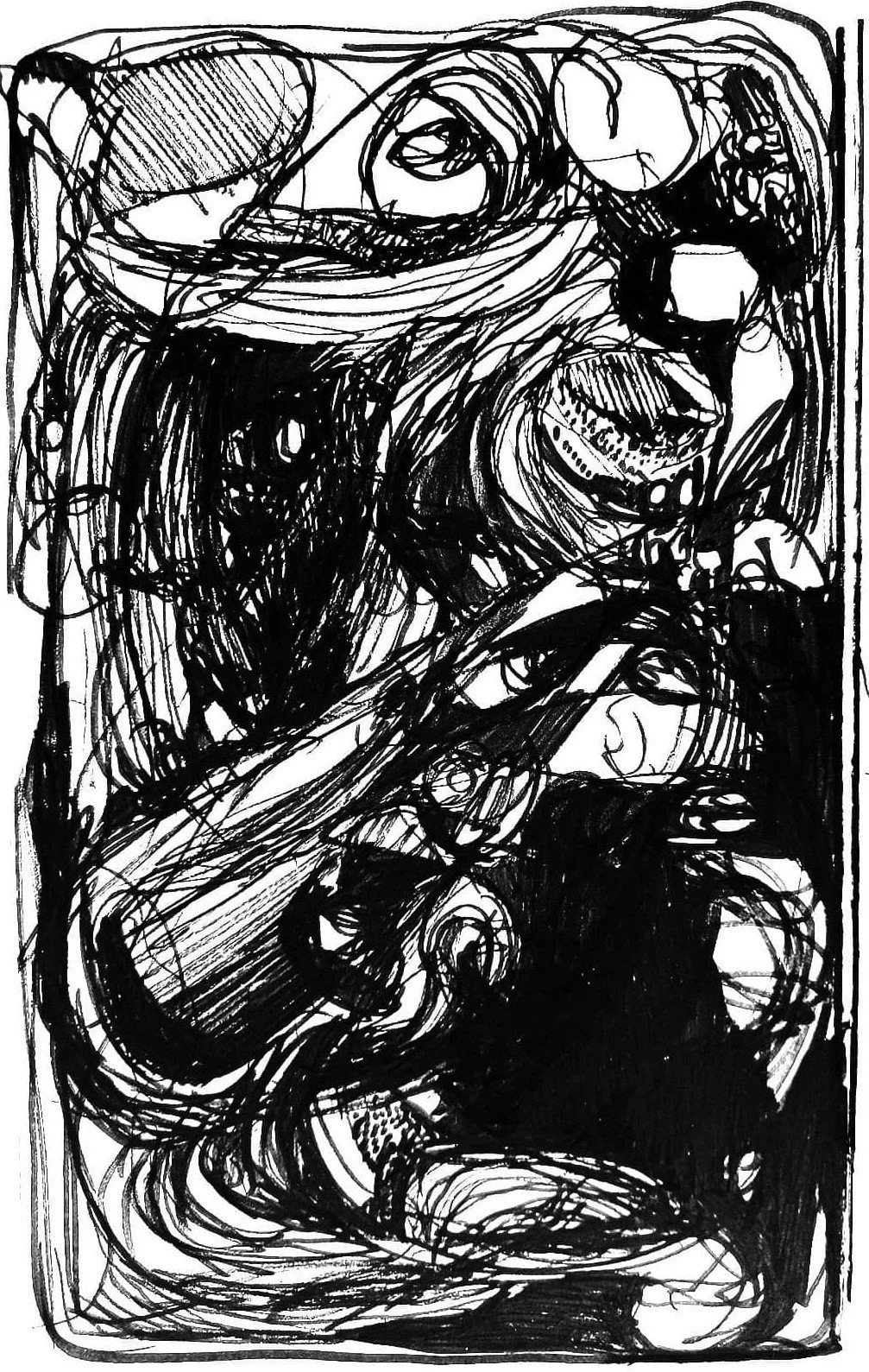
Vigil
This period brought insights that I believed to be real steps in genuine inner work — when in truth, I had nothing to do with them.
I was a dreamy, slightly “spiritual” type, caught in the illusion that through meditation and creating, I could somehow let go of the limiting beliefs that had been weighing down my life.
Still — at that level, I was getting to know myself in the only way I could.
And for that, gesture — or action painting — proved to be a powerful tool.

Fragmented self-conflicts
On the surface, I wasn’t trying to communicate anything — I simply wanted to move closer to that unnameable feeling the anxiety had left behind.
Release.
It’s interesting how a period of life can generate so many symbols carrying the same meaning, appearing in different forms — through the events of one’s personal reality.
Back then, everything revolved around release.
Just as the constant “scribbling,” the bouts of shouting that became a regular occurrence slowly turned into a ritual of their own.
Yes… I was unhinged enough that after Sunday lunch — with an axe in my bag — I would cycle out to the nearest forest to cut down (dead) trees, just to ease the pressure.
Foaming at the mouth, screaming.
I can only imagine what anyone passing by must have thought…
Anyway.
Sometimes you have to be a little insane — to break the rules and observe the whole circus from a few steps back.
That, too, is a form of honesty.
After these rituals, I would be completely absorbed in the act of “scribbling” — for minutes, sometimes hours.
As if a valve had opened, letting the lines and stains flow more and more freely, moving through the gestures of the moment.
The process of following the energy became far more important than the drawing itself.

Organic impressions
I had to attune myself to this pulsing rhythm, and learn to trust it as I was learning the foundations of a new language.
“Beautifully ugly” — as I used to repeat to myself back then.
This way of seeing was further shaped by the work of a few contemporary illustrators and typographers we were introduced to during my studies.
I wish I could remember those names — most likely Japanese — whose work was defined by the contrast between elegantly structured text and wildly expressive brushstrokes. But instead of taking notes, I was simply absorbed by what I saw.
That disarming contrast — the almost careless gestures — filled me with a sense of beauty, as the white space no longer functioned as a background, but as rhythm itself, structuring the dynamic between splattered impulses and disciplined, articulated text.
It felt as though this duality mirrored the fragmented inner conflicts of the mind — returning as a flow that was at once frenzied, yet conscious and controlled.
This was what I had been searching for.
I tried to recall that almost goosebump-inducing sensation as I began to create my own sketches — at first driven almost entirely by raw impulse.
And after a few weeks, as I gradually began to settle, I noticed something shifting — the rhythm of forms and flows slowly starting to evolve into conscious composition.
The first visible steps of a long journey were beginning to unfold.